
Innovation from Bulgaria: a new ECG device for at-home diagnostics saves lives
This article summarises a piece published elsewhere and links to the original. The headline is the outlet’s. The sections on the recording itself and on the limits of the method are CardiSong’s own description.
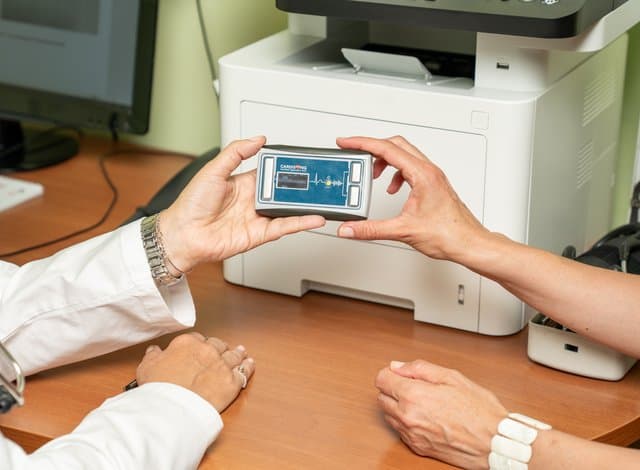
On 20 August 2025 Dariknews.bg published a piece on a new Bulgarian telemetric ECG device that records an electrocardiogram at home. The headline, “a new ECG device for at-home diagnostics”, is the outlet's wording. Below we report what it wrote, then describe the recording itself and the limits of the method as CardiSong describes them.
What Dariknews.bg reported
The article reports that a Bulgarian medical research company has built a portable telemetric ECG device that allows timely diagnosis of cardiological conditions and can save lives. The information is credited to Alexandrovska University Hospital.
With the device, patients will be able to examine themselves at home while the data is transmitted remotely to a doctor. Specialists can then analyse the result quickly and give guidance, which the outlet says makes early detection, monitoring and prevention of cardiovascular events easier.
The device was developed in the Biomedical Engineering laboratory at the Centre of Excellence in Mechatronics and Clean Technologies, Technical University of Sofia. The clinical studies were carried out at Alexandrovska University Hospital by Prof. Emil Manov and Dr Krasimira Koshtikova, who note that every patient will be able to record their ECG and send it to a specialist even as a sound signal over the phone. Alongside doctors and engineers, the project involves IT experts, product designers and patent attorneys.
The article adds that the device is expected to reach the market by the end of the year, and that its creators are working to have telemetric ECG monitoring added to the list of devices and services funded by the national health fund.
One clarification of our own. The article does not name the company; the description — a telemetric ECG device from the Technical University laboratory, with clinical studies at Alexandrovska and the signal sent as sound over the phone — matches the CardiSong device. The word “diagnostics” is the outlet's too: the CardiSong device and platform make no diagnosis. They deliver a good-quality recording to the doctor, who makes the clinical decisions.
How the recording is made
The CardiSong device produces the electrocardiogram as sound. You place the fingers of both hands on the steel electrodes, or hold the device against the chest at the spot your doctor has shown you. Before first use, your doctor shows you how to work with the device and when to record.
The recording itself lasts about 20 seconds. During that time the bottom of the phone rests 2–3 cm from the device, somewhere quiet, so the microphone picks up the signal cleanly. The device runs on two AA batteries, has no cables and needs no Bluetooth pairing.
The recording reaches the platform in one of two ways: through the CardiSong mobile app, which uses the phone's internet connection, or through the CardiSong phone line, which needs no internet at all. The app checks the quality of the recording and will not send a file whose sound was not captured reliably; the finished audio file is sent encrypted.
What the doctor does
The platform converts the audio file back into an electrocardiogram and shows it in your doctor's profile, alongside your earlier recordings in time order. No diagnosis is made automatically: the doctor sees the signal as received, reads it and sends you their opinion through the platform. Only your doctor and you have access to your recordings.
To start, you need to register with a doctor who works with CardiSong. The doctor decides when and how often you record, on a schedule or when symptoms appear.
What CardiSong does not do
CardiSong records heart activity only during a recording you start. It does not provide continuous monitoring and does not replace a prescribed Holter study or a standard 12-lead ECG. The device and the platform do not diagnose; reading the recording and giving an opinion remain your doctor's work.
Source: Dariknews.bg
Read original